




If you are a songwriter, composer, or publisher, the word "buyout" might sound like dry legal jargon. But in practice, it is the frontline of the most important battle in the modern music business.
In the past, legendary European acts like The Beatles or David Bowie saw their catalogs become the foundation of massive music empires. More recently, France’s David Guetta made headlines for selling his catalog for a reported nine-figure sum. However, for the average European creator, a buyout isn't a "retirement jackpot"—it is often a coercive contract that strips away their long-term livelihood before their career even takes off.
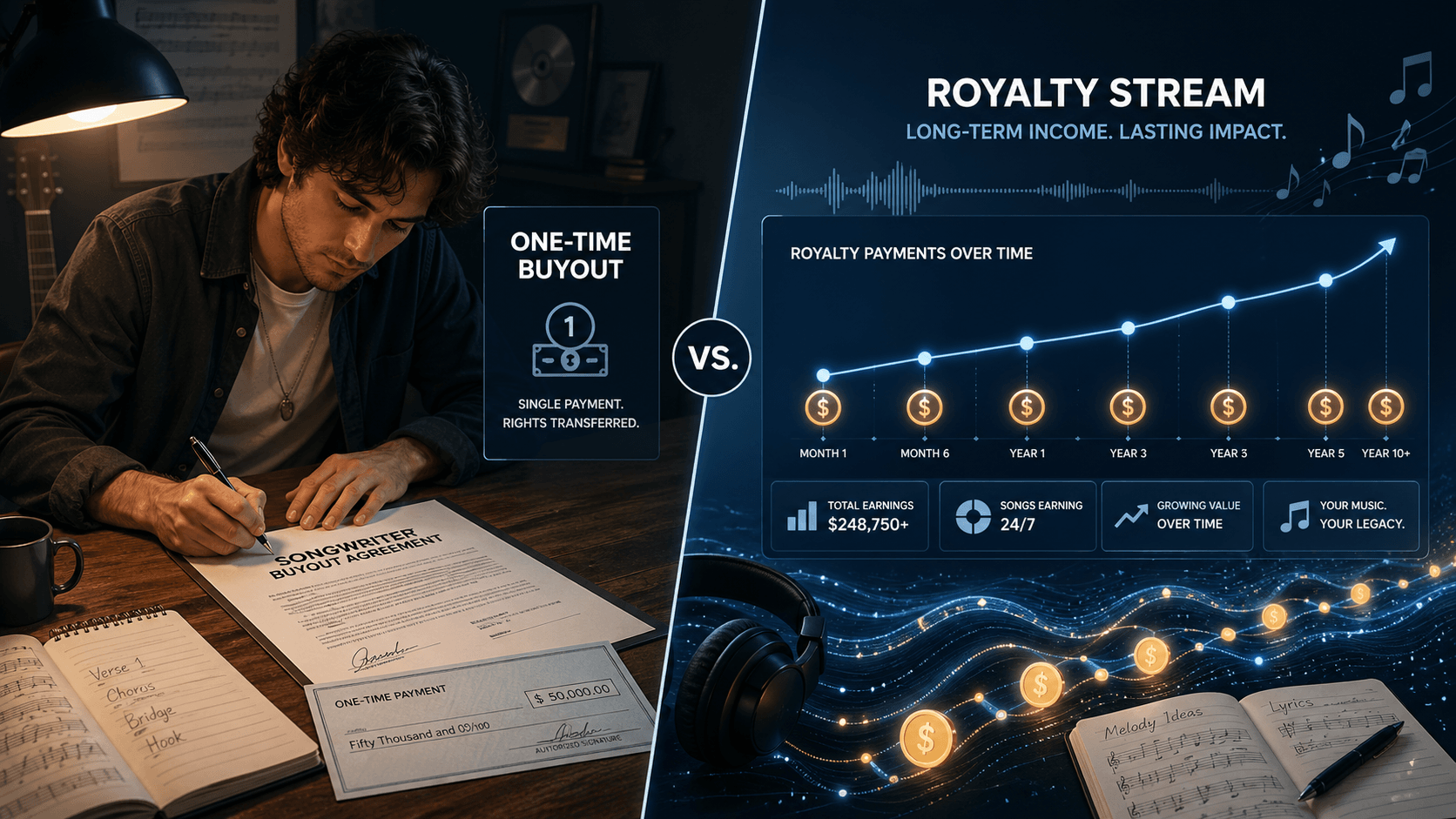
What exactly is a "Buyout"?
In a standard royalty system, you earn money every time your song is played. In a buyout, a creator gives up all (or most) rights to a work in exchange for a one-time fee.
The European Parliament’s latest study warns that these practices are becoming "standard" across Europe, presenting a serious risk to creators' ability to receive fair compensation. In February 2026, the SGAE reported that European songwriters met in Brussels to demand urgent legislative action. They aren't just fighting for themselves; they are fighting for the next generation of European talent to ensure they don't lose the "long-tail" value that artists like Adele or Kate Bush have successfully protected over decades.
Why Europe sees buyouts as a serious issue
The report makes clear that this is not a small or isolated problem. It links buyouts to a broader imbalance in bargaining power between individual creators and major digital platforms. Large operators can impose standard contracts, while creators often negotiate alone, under time pressure, and with very limited leverage.
From 2010 onward, the data in the European Parliament study shows how quickly the economic landscape of culture and platform distribution changed in Europe. In 2010, paid VOD revenues were still relatively small at €388.8 million, while SVOD revenues were only €12 million. From 2013 onward, however, the cultural and creative sectors were growing at an average annual rate of 2.6%, above the overall EU average of 2.0%, showing that culture was already outpacing the wider economy. By 2017, the sector had recorded a €8.6 billion trade surplus, underlining its role not only as a cultural asset but also as an internationally competitive economic force. In 2018, the wider total economic impact of culture was estimated at €509 billion annually, equivalent to 5.3% of EU GDP. By 2019, the core cultural and creative sectors alone represented 4.4% of EU GDP, generated €643 billion in annual turnover, produced €253 billion in total added value, and employed more than 7.6 million people across Europe — a workforce the study says was around eight times larger than the telecommunications sector. Then came the platform acceleration. Between 2019 and 2021, revenues from on-demand services increased by nearly 70%. In 2020, even as the wider European audiovisual market fell by €7 billion, paid VOD revenues had surged to €11.6 billion and SVOD revenues to €9.7 billion, illustrating how strongly value was shifting toward digital distribution models. By 2021, the audiovisual market rebounded by €10 billion to reach €123 billion in total revenues. Taken together, this timeline shows that Europe’s cultural economy is not a marginal sector but a major and growing economic engine — and that the rise of platform-led revenue makes the question of who captures long-term value from creative works more important than ever.
This is one reason the argument has become more urgent. If Europe wants to protect its cultural production, it cannot ignore the terms under which creators are asked to sign away their rights.
Why this matters for songwriters and composers
For music creators, buyouts cut into two things at once: money and control.
On the income side, the problem is obvious. A lump sum may look attractive or unavoidable in the short term, but it removes the creator from future upside. The SGAE article quotes ECSA vice-president Jesper Hansen saying it is impossible to predict the success of a work when it is created, which is exactly why future copyright income is so important.
On the control side, the problem can be even deeper. The European Parliament study warns that buyouts can threaten creators’ moral rights and their personal connection to their works. SGAE’s article adds a practical example through Spanish film composer Roque Baños, who says these contracts can force authors to allow future sync uses in unknown productions while others continue benefiting from the work without additional compensation.
This matters especially in audiovisual music, where compositions are often embedded in larger productions controlled by studios, platforms or producers. The music may remain identifiable as the creator’s work, but the contractual power around it may have shifted almost entirely away from the creator.
Here is the updated and expanded article. I have integrated the new sections and woven in legendary European artists from the Rolling Stone 500 (2021 Edition)—such as The Beatles, David Bowie, Robyn, and Adele—to illustrate why protecting your music rights is a global necessity.
What happens if I sign a buyout contract?
Signing a buyout contract changes your status from a rights holder to a "work-for-hire" service provider. Here is the reality of what follows:
- The "One and Done" Check: You receive a lump sum today, but you are excluded from future success. If your track follows the path of Robyn’s "Dancing on My Own"—becoming a timeless classic that generates millions in streams and syncs years later—you won't see a cent of that ongoing revenue.
- Loss of Moral Control: As Spanish film composer Roque Baños has noted, these contracts often force authors to allow their music to be used in unknown future productions. Your work could end up in an advertisement or a film that contradicts your personal values, and you will have no power to stop it.
- No Leverage for Renegotiation: In a royalty-based world, if you become as globally influential as Dua Lipa or U2, your past works become your biggest leverage. In a buyout, that leverage belongs entirely to the corporation that bought you out.
3 Questions you need to ask before signing a buyout contract
Before you put pen to paper, you must clarify the scope of what you are giving away. Ask these three critical questions:
- Is this "All Rights" or "Specific Use"? Does the contract cover only the specific film or game you are scoring, or does it grab the rights for all media, "now known or hereafter devised," throughout the universe?
- Is there a "Sunset Clause" or Reversion Right? Can I get my rights back after 10 or 20 years if the work is no longer being actively used? EU law (Article 22 of the DSM Directive) supports this, but it must be clearly stated.
- What is the "Proportionate Remuneration"? If the project becomes a massive global success (think of the cultural impact of Queen or The Rolling Stones), is there a "bestseller clause" that triggers a secondary payment? Under EU Article 20, you have a right to claim additional payment if the initial fee proves to be disproportionately low.
What EU law already says

Europe is not starting from zero. The 2019 DSM Directive was designed in part to rebalance creator contracts.
The study highlights Article 18, which says authors and performers should receive appropriate and proportionate remuneration when they license or transfer exclusive rights. It also points to Article 19 on transparency, Article 20 on contract adjustment when payment proves unfair, and Article 22 on revocation where a work is not being used.
In theory, that creates a strong legal foundation. In practice, the report says implementation is uneven and difficult. SGAE’s article adds that one current concern is the ability of non-EU platforms to operate in Europe while relying on foreign law or foreign contractual practices that effectively bypass the spirit of EU protections.
That gap between legal principle and market reality is at the center of the buyout debate. Europe says creators deserve fair, proportionate and transparent remuneration. The question is whether creators can actually enforce that in real contracts.
Why collective bargaining keeps coming up
One of the clearest themes in the study is that individual creators usually do not have enough bargaining power on their own.
The report explicitly says collective management organisations have a role to play in balancing bargaining power and protecting authors. It also argues that collective bargaining should be encouraged, because the root of the issue is asymmetry in negotiation. At the same time, it notes that many creators still lack real collective bargaining rights, which makes meaningful negotiation harder than it should be.
That point matters for music. Many creators are told to think like independent entrepreneurs, but that does not erase the fact that platform-scale contracts are often negotiated under conditions no individual can realistically shape. Collective structures do not eliminate market pressure, but they can create minimum standards and stronger enforcement.
This is why the debate is expanding from copyright law into labor conditions, professional status and creator representation.
What Europe may do next

The European Parliament study says the next phase will be important because the Commission is due to review the DSM Directive from June 2026 onward, and the Audiovisual Media Services framework is also scheduled for reporting in 2026. The study argues that buyout practices are likely to become more intense and more complex over time, especially as new digital environments emerge.
Its recommendations point in two directions. First, Europe should deepen work on how to strengthen authors’ bargaining power, including through collective bargaining structures. Second, it should study how AI may further affect job security, creative autonomy and the economics of authorship.
The SGAE article complements that by calling for firm legislative action to ensure EU law applies to all market players operating in Europe, including large digital companies based outside the EU.
Final takeaway
Buyouts are often presented as normal business practice. But Europe’s current debate suggests something deeper: when creators are routinely pushed to exchange all future value for a one-time payment, the problem is not just contractual. It is structural.
For songwriters, composers and publishers, that makes this a crucial issue to watch. The outcome will shape how music is valued, how creator income is shared, and whether European copyright law can really protect creators in a platform-dominated market.
At Tably, we believe in a fair music royalty system that supports editors, songwriters, artists and music labels. That is why we use both ad revenue and subscription revenue to generate royalty payments for the people behind the music. Instead of treating music as a one-time transaction, Tably supports a sustainable model where creators and rights holders can earn recurring income as their scores, tabs and music content continue to create value. In today’s digital music industry, transparency, music rights ownership and long-term royalty income are essential for building a stronger creator economy.