
Description
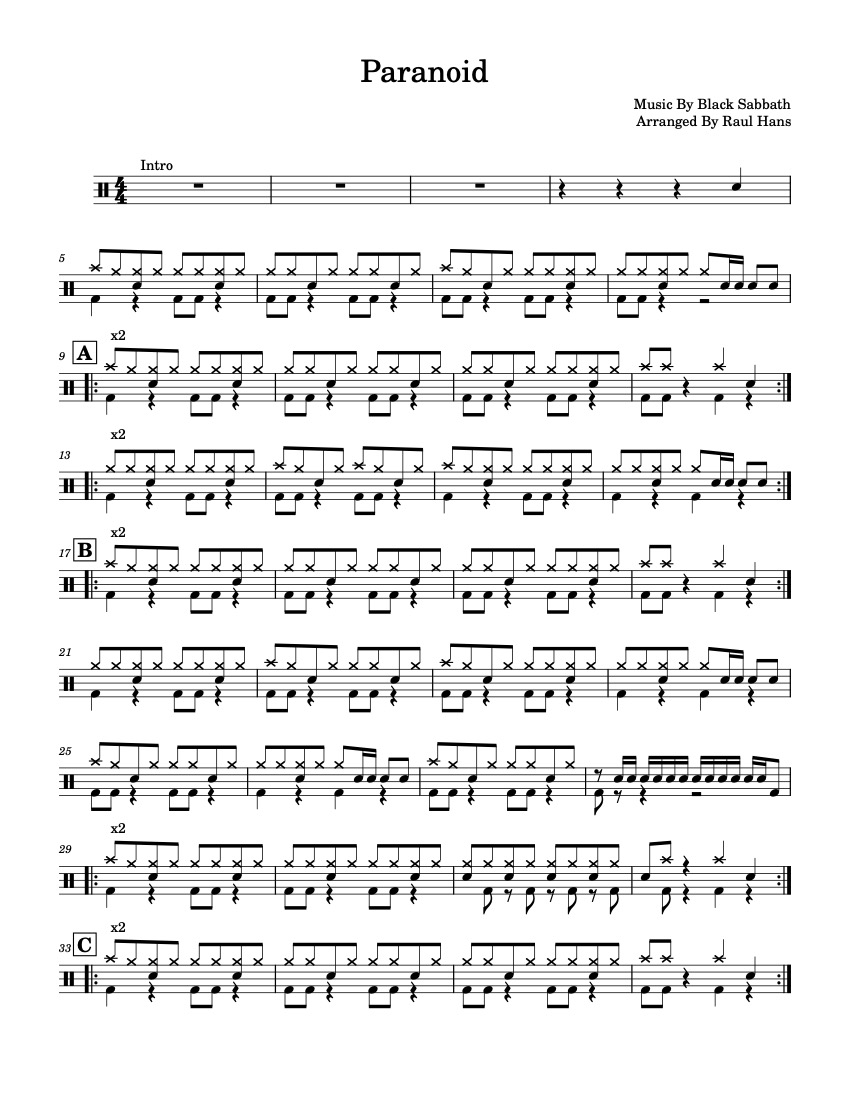
“Paranoid” by Black Sabbath is a heavy metal and proto-punk song from the band’s second studio album, Paranoid. It was released in August 1970 through Vertigo Records, with “The Wizard” as the original B-side. The song was recorded on June 16, 1970 at Island Studios in London, written by Geezer Butler, Tony Iommi, Ozzy Osbourne, and Bill Ward, and produced by Rodger Bain.
Musically, the song is built around one of Tony Iommi’s most recognizable guitar riffs. The main personnel is Ozzy Osbourne on vocals, Tony Iommi on guitar, Geezer Butler on bass, and Bill Ward on drums. The arrangement is stripped down and direct, relying on distorted guitar, bass, drums, and Osbourne’s urgent vocal delivery rather than elaborate studio layering.
The song is in E minor pentatonic and is constructed largely from power chords, which helps give it its blunt, driving sound. Iommi’s guitar solo was recorded with a dry signal in the left channel and then processed through a ring modulator into the right channel, creating an unusual stereo effect.
One of the biggest curiosities about “Paranoid” is how quickly it was written. Black Sabbath had essentially finished the album but needed a short track to fill the remaining space. Tony Iommi came up with the riff, Geezer Butler quickly wrote the lyrics, and Ozzy Osbourne reportedly read them as he sang. The song that began as a last-minute filler ended up becoming one of the band’s most famous recordings.
The song’s success also changed the identity of the album itself. Black Sabbath originally intended to call their second album War Pigs, after another track on the record, but the record company preferred the less controversial title Paranoid. As a result, the quickly written filler song ended up giving the entire album its name.
Lyrically, “Paranoid” deals with alienation, depression, emotional numbness, and the feeling of being unable to enjoy life. Its title suggests paranoia, but the lyrics themselves are closer to a portrait of psychological distress and disconnection than a literal description of paranoid thinking.
Another curiosity is that the song caused controversy because one lyric was widely misheard. The line “I tell you to enjoy life” was sometimes interpreted as “I tell you to end your life,” which led to accusations that the track encouraged suicide. That misunderstanding later became especially notable because Ozzy Osbourne faced similar controversy over his solo song “Suicide Solution.”
Commercially, “Paranoid” became Black Sabbath’s first song to chart in both the United Kingdom and the United States. It reached No. 4 on the UK Singles Chart and No. 61 on the Billboard Hot 100. It also reached No. 1 in countries including Germany and Denmark, helping establish Black Sabbath internationally.
The song has since become one of the defining recordings of heavy metal. It has appeared repeatedly on major lists of influential rock and metal songs, including the Rock and Roll Hall of Fame’s selection of songs that shaped rock and roll, while Rolling Stone has ranked it among both the greatest songs and the greatest heavy metal songs of all time.
Its long-term reputation comes from the combination of Iommi’s instantly recognizable riff, Butler’s dark lyrics, Ward’s relentless drumming, and Osbourne’s tense vocal performance. What began as a short piece created to fill album space ultimately became one of Black Sabbath’s signature songs and one of the foundational tracks of heavy metal.
Lyrics
Finished with my woman 'cause she
Couldn't help me with my mind
People think I'm insane because
I am frowning all the time
All day long, I think of things
But nothing seems to satisfy
Think I'll lose my mind if I don't
Find something to pacify
Can you help me
Occupy my brain?
Whoa, yeah
I need someone to show me
The things in life that I can't find
I can't see the things that make true happiness
I must be blind
Make a joke and I will sigh
And you will laugh and I will cry
Happiness, I cannot feel
And love to me is so unreal
And so, as you hear these words
Telling you now of my state
I tell you to enjoy life, I wish I could
But it's too late
Youtube Video
Social Links
Song
Description
“Paranoid” by Black Sabbath is a heavy metal and proto-punk song from the band’s second studio album, Paranoid. It was released in August 1970 through Vertigo Records, with “The Wizard” as the original B-side. The song was recorded on June 16, 1970 at Island Studios in London, written by Geezer Butler, Tony Iommi, Ozzy Osbourne, and Bill Ward, and produced by Rodger Bain.
Musically, the song is built around one of Tony Iommi’s most recognizable guitar riffs. The main personnel is Ozzy Osbourne on vocals, Tony Iommi on guitar, Geezer Butler on bass, and Bill Ward on drums. The arrangement is stripped down and direct, relying on distorted guitar, bass, drums, and Osbourne’s urgent vocal delivery rather than elaborate studio layering.
The song is in E minor pentatonic and is constructed largely from power chords, which helps give it its blunt, driving sound. Iommi’s guitar solo was recorded with a dry signal in the left channel and then processed through a ring modulator into the right channel, creating an unusual stereo effect.
One of the biggest curiosities about “Paranoid” is how quickly it was written. Black Sabbath had essentially finished the album but needed a short track to fill the remaining space. Tony Iommi came up with the riff, Geezer Butler quickly wrote the lyrics, and Ozzy Osbourne reportedly read them as he sang. The song that began as a last-minute filler ended up becoming one of the band’s most famous recordings.
The song’s success also changed the identity of the album itself. Black Sabbath originally intended to call their second album War Pigs, after another track on the record, but the record company preferred the less controversial title Paranoid. As a result, the quickly written filler song ended up giving the entire album its name.
Lyrically, “Paranoid” deals with alienation, depression, emotional numbness, and the feeling of being unable to enjoy life. Its title suggests paranoia, but the lyrics themselves are closer to a portrait of psychological distress and disconnection than a literal description of paranoid thinking.
Another curiosity is that the song caused controversy because one lyric was widely misheard. The line “I tell you to enjoy life” was sometimes interpreted as “I tell you to end your life,” which led to accusations that the track encouraged suicide. That misunderstanding later became especially notable because Ozzy Osbourne faced similar controversy over his solo song “Suicide Solution.”
Commercially, “Paranoid” became Black Sabbath’s first song to chart in both the United Kingdom and the United States. It reached No. 4 on the UK Singles Chart and No. 61 on the Billboard Hot 100. It also reached No. 1 in countries including Germany and Denmark, helping establish Black Sabbath internationally.
The song has since become one of the defining recordings of heavy metal. It has appeared repeatedly on major lists of influential rock and metal songs, including the Rock and Roll Hall of Fame’s selection of songs that shaped rock and roll, while Rolling Stone has ranked it among both the greatest songs and the greatest heavy metal songs of all time.
Its long-term reputation comes from the combination of Iommi’s instantly recognizable riff, Butler’s dark lyrics, Ward’s relentless drumming, and Osbourne’s tense vocal performance. What began as a short piece created to fill album space ultimately became one of Black Sabbath’s signature songs and one of the foundational tracks of heavy metal.
Lyrics
Finished with my woman 'cause she
Couldn't help me with my mind
People think I'm insane because
I am frowning all the time
All day long, I think of things
But nothing seems to satisfy
Think I'll lose my mind if I don't
Find something to pacify
Can you help me
Occupy my brain?
Whoa, yeah
I need someone to show me
The things in life that I can't find
I can't see the things that make true happiness
I must be blind
Make a joke and I will sigh
And you will laugh and I will cry
Happiness, I cannot feel
And love to me is so unreal
And so, as you hear these words
Telling you now of my state
I tell you to enjoy life, I wish I could
But it's too late