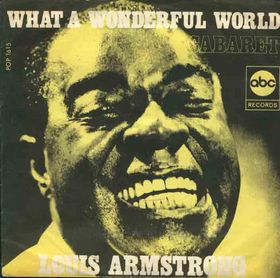

Description
“What a Wonderful World” by Louis Armstrong is one of the most beloved traditional pop songs of the 20th century. First recorded on August 16, 1967 and released in September 1967, the song was issued by ABC Records and later included on Armstrong’s album What a Wonderful World. It was written by Bob Thiele, using the pseudonym George Douglas, and George David Weiss, with Thiele also serving as producer.
Musically, “What a Wonderful World” blends traditional pop and R&B with a gentle orchestral ballad style. The arrangement is built around Louis Armstrong’s warm, gravelly lead vocal, supported by a soft orchestra with strings, brass, woodwinds, piano, bass, drums, and delicate background textures. The song’s slow tempo and elegant instrumentation create a peaceful, reflective atmosphere that contrasts with the social tension of the 1960s.
The lyrics describe simple images of beauty in everyday life: trees, roses, blue skies, clouds, rainbows, friends shaking hands, and babies growing up. Rather than focusing on romance or personal heartbreak, the song presents a universal message of hope, gratitude, and human connection. Its emotional power comes from the contrast between Armstrong’s weathered voice and the innocence of the words.
“What a Wonderful World” had an unusual chart history. It became a major success in the United Kingdom, reaching No. 1 on the UK Singles Chart in April 1968 and becoming the UK’s biggest-selling single of that year. In the United States, however, it initially performed poorly because ABC Records president Larry Newton disliked the song and refused to promote it. The song later found a second life after being featured in the 1987 film Good Morning, Vietnam, and its 1988 reissue reached No. 32 on the Billboard Hot 100.
One curiosity about the song is that it was written specifically for Louis Armstrong. George David Weiss said he was inspired by Armstrong’s ability to bring people of different races together, while Bob Thiele wanted to create a hopeful song during a period marked by the Kennedy assassination, the Vietnam War, racial conflict, and national unrest.
Another famous studio story involves the recording session in Las Vegas. Armstrong recorded the song at United Recording after a midnight show at the Tropicana Hotel. During the session, Larry Newton reportedly tried to stop the recording because he wanted a more upbeat, “Hello, Dolly!”-style hit. He was eventually removed from the studio, and Armstrong continued recording with the orchestra. The session was also interrupted twice by nearby freight train horns, forcing the musicians to restart.
A final notable detail is Armstrong’s generosity during the session. Because the recording went longer than planned and the orchestra needed to be paid overtime, Armstrong accepted only $250 union scale for his own work so the musicians could be compensated properly.
The song’s legacy has grown enormously over time. Armstrong’s recording was inducted into the Grammy Hall of Fame in 1999, became a pop standard, and has appeared in films, television, commercials, and cover versions by many artists. From an SEO and music discovery perspective, “What a Wonderful World” is ideal for listeners searching for Louis Armstrong songs, classic pop standards, hopeful songs, songs about peace, orchestral ballads, traditional pop, or music from Good Morning Vietnam. Its tender arrangement, optimistic lyrics, and Armstrong’s unmistakable voice have made it one of the most enduring songs in popular music history.
Lyrics
I see trees of green, red roses too
I see them bloom for me and you
And I think to myself: What a wonderful world
I see skies of blue and clouds of white
The bright blessed days, the dark sacred night
And I think to myself: What a wonderful world
The colors of the rainbow, so pretty in the sky
Are also on the faces of people going by
I see friends shaking hands, saying: How do you do?
They're really saying: I love you!
I hear babies crying, I watch them grow
They'll learn much more, than I'll never know
And I think to myself: What a wonderful world
Yes, I think to myself: What a wonderful world
Youtube video
Songs links
Specification
“What a Wonderful World” by Louis Armstrong is one of the most beloved traditional pop songs of the 20th century. First recorded on August 16, 1967 and released in September 1967, the song was issued by ABC Records and later included on Armstrong’s album What a Wonderful World. It was written by Bob Thiele, using the pseudonym George Douglas, and George David Weiss, with Thiele also serving as producer.
Musically, “What a Wonderful World” blends traditional pop and R&B with a gentle orchestral ballad style. The arrangement is built around Louis Armstrong’s warm, gravelly lead vocal, supported by a soft orchestra with strings, brass, woodwinds, piano, bass, drums, and delicate background textures. The song’s slow tempo and elegant instrumentation create a peaceful, reflective atmosphere that contrasts with the social tension of the 1960s.
The lyrics describe simple images of beauty in everyday life: trees, roses, blue skies, clouds, rainbows, friends shaking hands, and babies growing up. Rather than focusing on romance or personal heartbreak, the song presents a universal message of hope, gratitude, and human connection. Its emotional power comes from the contrast between Armstrong’s weathered voice and the innocence of the words.
“What a Wonderful World” had an unusual chart history. It became a major success in the United Kingdom, reaching No. 1 on the UK Singles Chart in April 1968 and becoming the UK’s biggest-selling single of that year. In the United States, however, it initially performed poorly because ABC Records president Larry Newton disliked the song and refused to promote it. The song later found a second life after being featured in the 1987 film Good Morning, Vietnam, and its 1988 reissue reached No. 32 on the Billboard Hot 100.
One curiosity about the song is that it was written specifically for Louis Armstrong. George David Weiss said he was inspired by Armstrong’s ability to bring people of different races together, while Bob Thiele wanted to create a hopeful song during a period marked by the Kennedy assassination, the Vietnam War, racial conflict, and national unrest.
Another famous studio story involves the recording session in Las Vegas. Armstrong recorded the song at United Recording after a midnight show at the Tropicana Hotel. During the session, Larry Newton reportedly tried to stop the recording because he wanted a more upbeat, “Hello, Dolly!”-style hit. He was eventually removed from the studio, and Armstrong continued recording with the orchestra. The session was also interrupted twice by nearby freight train horns, forcing the musicians to restart.
A final notable detail is Armstrong’s generosity during the session. Because the recording went longer than planned and the orchestra needed to be paid overtime, Armstrong accepted only $250 union scale for his own work so the musicians could be compensated properly.
The song’s legacy has grown enormously over time. Armstrong’s recording was inducted into the Grammy Hall of Fame in 1999, became a pop standard, and has appeared in films, television, commercials, and cover versions by many artists. From an SEO and music discovery perspective, “What a Wonderful World” is ideal for listeners searching for Louis Armstrong songs, classic pop standards, hopeful songs, songs about peace, orchestral ballads, traditional pop, or music from Good Morning Vietnam. Its tender arrangement, optimistic lyrics, and Armstrong’s unmistakable voice have made it one of the most enduring songs in popular music history.
Specification
“What a Wonderful World” by Louis Armstrong is one of the most beloved traditional pop songs of the 20th century. First recorded on August 16, 1967 and released in September 1967, the song was issued by ABC Records and later included on Armstrong’s album What a Wonderful World. It was written by Bob Thiele, using the pseudonym George Douglas, and George David Weiss, with Thiele also serving as producer.
Musically, “What a Wonderful World” blends traditional pop and R&B with a gentle orchestral ballad style. The arrangement is built around Louis Armstrong’s warm, gravelly lead vocal, supported by a soft orchestra with strings, brass, woodwinds, piano, bass, drums, and delicate background textures. The song’s slow tempo and elegant instrumentation create a peaceful, reflective atmosphere that contrasts with the social tension of the 1960s.
The lyrics describe simple images of beauty in everyday life: trees, roses, blue skies, clouds, rainbows, friends shaking hands, and babies growing up. Rather than focusing on romance or personal heartbreak, the song presents a universal message of hope, gratitude, and human connection. Its emotional power comes from the contrast between Armstrong’s weathered voice and the innocence of the words.
“What a Wonderful World” had an unusual chart history. It became a major success in the United Kingdom, reaching No. 1 on the UK Singles Chart in April 1968 and becoming the UK’s biggest-selling single of that year. In the United States, however, it initially performed poorly because ABC Records president Larry Newton disliked the song and refused to promote it. The song later found a second life after being featured in the 1987 film Good Morning, Vietnam, and its 1988 reissue reached No. 32 on the Billboard Hot 100.
One curiosity about the song is that it was written specifically for Louis Armstrong. George David Weiss said he was inspired by Armstrong’s ability to bring people of different races together, while Bob Thiele wanted to create a hopeful song during a period marked by the Kennedy assassination, the Vietnam War, racial conflict, and national unrest.
Another famous studio story involves the recording session in Las Vegas. Armstrong recorded the song at United Recording after a midnight show at the Tropicana Hotel. During the session, Larry Newton reportedly tried to stop the recording because he wanted a more upbeat, “Hello, Dolly!”-style hit. He was eventually removed from the studio, and Armstrong continued recording with the orchestra. The session was also interrupted twice by nearby freight train horns, forcing the musicians to restart.
A final notable detail is Armstrong’s generosity during the session. Because the recording went longer than planned and the orchestra needed to be paid overtime, Armstrong accepted only $250 union scale for his own work so the musicians could be compensated properly.
The song’s legacy has grown enormously over time. Armstrong’s recording was inducted into the Grammy Hall of Fame in 1999, became a pop standard, and has appeared in films, television, commercials, and cover versions by many artists. From an SEO and music discovery perspective, “What a Wonderful World” is ideal for listeners searching for Louis Armstrong songs, classic pop standards, hopeful songs, songs about peace, orchestral ballads, traditional pop, or music from Good Morning Vietnam. Its tender arrangement, optimistic lyrics, and Armstrong’s unmistakable voice have made it one of the most enduring songs in popular music history.
Specification
“What a Wonderful World” by Louis Armstrong is one of the most beloved traditional pop songs of the 20th century. First recorded on August 16, 1967 and released in September 1967, the song was issued by ABC Records and later included on Armstrong’s album What a Wonderful World. It was written by Bob Thiele, using the pseudonym George Douglas, and George David Weiss, with Thiele also serving as producer.
Musically, “What a Wonderful World” blends traditional pop and R&B with a gentle orchestral ballad style. The arrangement is built around Louis Armstrong’s warm, gravelly lead vocal, supported by a soft orchestra with strings, brass, woodwinds, piano, bass, drums, and delicate background textures. The song’s slow tempo and elegant instrumentation create a peaceful, reflective atmosphere that contrasts with the social tension of the 1960s.
The lyrics describe simple images of beauty in everyday life: trees, roses, blue skies, clouds, rainbows, friends shaking hands, and babies growing up. Rather than focusing on romance or personal heartbreak, the song presents a universal message of hope, gratitude, and human connection. Its emotional power comes from the contrast between Armstrong’s weathered voice and the innocence of the words.
“What a Wonderful World” had an unusual chart history. It became a major success in the United Kingdom, reaching No. 1 on the UK Singles Chart in April 1968 and becoming the UK’s biggest-selling single of that year. In the United States, however, it initially performed poorly because ABC Records president Larry Newton disliked the song and refused to promote it. The song later found a second life after being featured in the 1987 film Good Morning, Vietnam, and its 1988 reissue reached No. 32 on the Billboard Hot 100.
One curiosity about the song is that it was written specifically for Louis Armstrong. George David Weiss said he was inspired by Armstrong’s ability to bring people of different races together, while Bob Thiele wanted to create a hopeful song during a period marked by the Kennedy assassination, the Vietnam War, racial conflict, and national unrest.
Another famous studio story involves the recording session in Las Vegas. Armstrong recorded the song at United Recording after a midnight show at the Tropicana Hotel. During the session, Larry Newton reportedly tried to stop the recording because he wanted a more upbeat, “Hello, Dolly!”-style hit. He was eventually removed from the studio, and Armstrong continued recording with the orchestra. The session was also interrupted twice by nearby freight train horns, forcing the musicians to restart.
A final notable detail is Armstrong’s generosity during the session. Because the recording went longer than planned and the orchestra needed to be paid overtime, Armstrong accepted only $250 union scale for his own work so the musicians could be compensated properly.
The song’s legacy has grown enormously over time. Armstrong’s recording was inducted into the Grammy Hall of Fame in 1999, became a pop standard, and has appeared in films, television, commercials, and cover versions by many artists. From an SEO and music discovery perspective, “What a Wonderful World” is ideal for listeners searching for Louis Armstrong songs, classic pop standards, hopeful songs, songs about peace, orchestral ballads, traditional pop, or music from Good Morning Vietnam. Its tender arrangement, optimistic lyrics, and Armstrong’s unmistakable voice have made it one of the most enduring songs in popular music history.