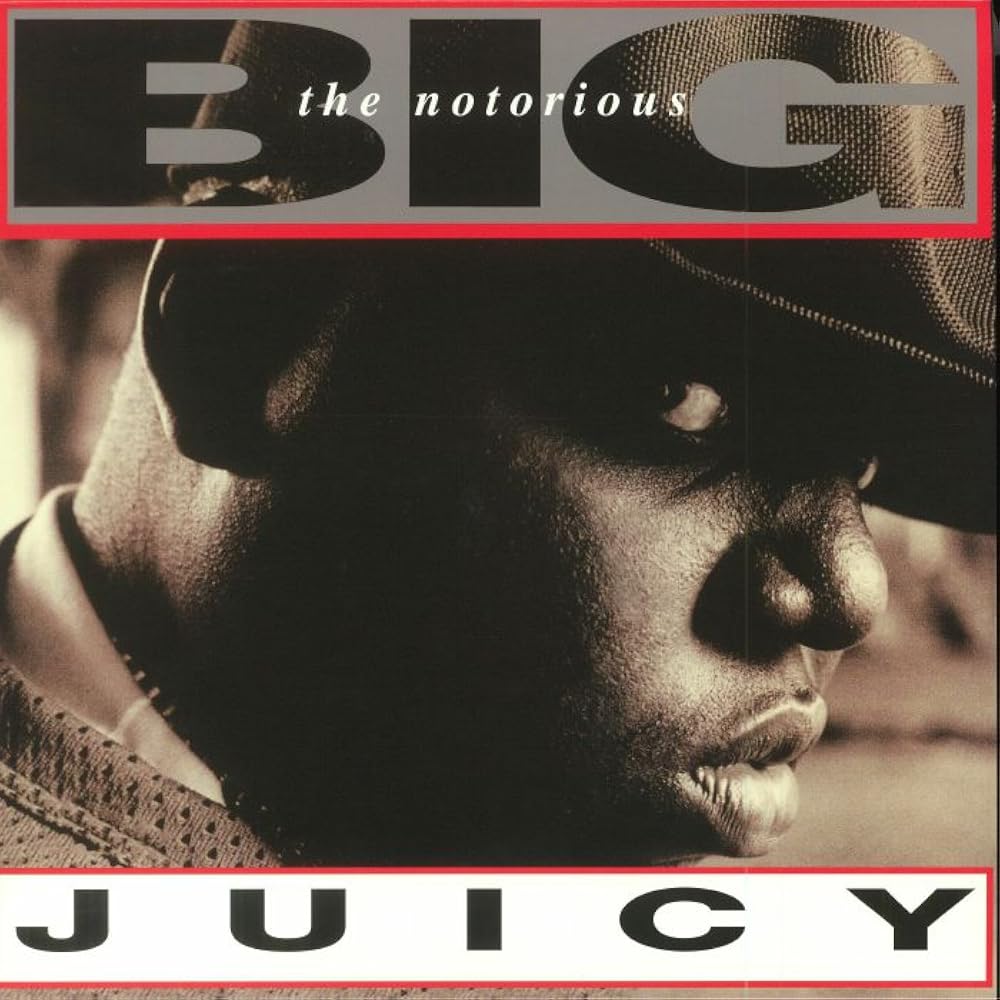

Description
“Juicy” by The Notorious B.I.G. is an East Coast hip-hop song from his 1994 debut album, Ready to Die. Released on August 9, 1994, it served as the album’s first single and was issued through Bad Boy Records and Arista Records, with “Unbelievable” as the B-side. The track was recorded at The Hit Factory in New York City, written by Christopher Wallace, Sean Combs, Jean-Claude Olivier, and James Mtume, and produced by Sean “Puffy” Combs and Poke of Trackmasters.
Musically, “Juicy” is built around a prominent sample from Mtume’s 1983 song “Juicy Fruit,” specifically its “Fruity Instrumental” mix. Rather than relying on a traditional live-band arrangement, the production uses the sampled instrumental as the foundation for Biggie’s verses, hip-hop drums, a smooth melodic groove, and an alternative chorus performed by Total together with Sean Combs. The article does not provide a complete instrument-by-instrument personnel list for the recording.
The smooth, soulful production creates a deliberate contrast with The Notorious B.I.G.’s deep voice and detailed storytelling. While much of Ready to Die explores darker subjects, “Juicy” has a celebratory quality, turning the polished R&B sample into the backdrop for one of hip-hop’s best-known success stories.
Lyrically, the song is a classic rags-to-riches narrative. Biggie looks back on growing up in poverty, dreaming about becoming a rapper, listening to his early musical influences, dealing drugs, experiencing criminal involvement, and eventually achieving wealth and recognition through music. The contrast between his difficult childhood and his new lifestyle is central to the song.
One curiosity is that “Juicy” contains a reference to the World Trade Center, with Biggie comparing his growing success to an explosion. The lyric referred to the 1993 World Trade Center bombing, which had occurred the previous year. After the September 11 attacks in 2001, some radio stations removed the words “World Trade” from broadcasts of the song because of sensitivity surrounding the attacks.
That edit later caused an unusual misunderstanding. Because The Notorious B.I.G. died in 1997, four years before September 11, some listeners unfamiliar with the 1993 bombing incorrectly interpreted the original lyric as a prediction of the 2001 attacks. The uncensored lyric remained intact on albums, downloads, and the music video even while some radio versions continued using the edit.
Another major curiosity concerns the song’s production. Pete Rock later claimed that Sean Combs heard a beat he had created using the same “Juicy Fruit” sample and then used the concept for “Juicy” without crediting him as the original creator. Pete Rock subsequently produced an official remix of the song using the same sample and said that, although he no longer held serious resentment about the situation, he believed he deserved proper recognition.
The music video was directed by Sean Combs and premiered in August 1994. It visually recreates the song’s autobiographical story, showing Biggie in situations connected to poverty, selling drugs, being arrested, arguing with his mother, and later enjoying his success at a pool party. The contrast between these scenes mirrors the transformation described in the lyrics.
“Juicy” became one of the defining recordings of The Notorious B.I.G.’s career and has frequently been ranked among the greatest hip-hop songs ever made. Rolling Stone originally placed it at No. 424 on its list of the 500 Greatest Songs of All Time before moving it dramatically higher to No. 32 in its 2021 revision. The BBC also ranked it No. 1 on its list of the greatest hip-hop songs of all time.
Its lasting appeal comes from the combination of Biggie’s autobiographical storytelling, relaxed but precise flow, the warm “Juicy Fruit” sample, and the contrast between memories of hardship and the celebration of success. The track helped establish the larger-than-life personality that would become central to The Notorious B.I.G.’s legacy while remaining grounded in the circumstances of his early life.
Lyrics
(Fuck all you hoes! Get a grip, motherfucker!)
Yeah, this album is dedicated
To all the teachers that told me I'd never amount to nothin'
To all the people that lived above the buildings that I was hustlin' in front of
Called the police on me when I was just tryin' to make some money to feed my daughter (it's all good)
And all the niggas in the struggle
You know what I'm sayin'? It's all good, baby, baby
It was all a dream, I used to read Word Up! Magazine
Salt-n-Pepa and Heavy D up in the limousine
Hangin' pictures on my wall
Every Saturday rap Attack, Mr. Magic, Marley Marl
I let my tape rock till my tape popped
Smokin' weed in Bambú, sippin' on Private Stock
Way back, when I had the red and black lumberjack
With the hat to match
Remember Rappin' Duke? Duh-ha, duh-ha
You never thought that hip-hop would take it this far
Now I'm in the limelight 'cause I rhyme tight
Time to get paid, blow up like the World Trade
Born sinner, the opposite of a winner
Remember when I used to eat sardines for dinner
Peace to Ron G, Brucie B, Kid Capri
Funkmaster Flex, Lovebug Starski
I'm blowin' up like you thought I would
Call the crib, same number, same hood, it's all good
And if you don't know, now you know, nigga
You know very well (yeah)
Who you are (money, hoes and clothes)
Don't let 'em hold you down (bankrolls, yeah, haha)
Reach for the stars (it's all good)
You had a goal (c'mon)
But not that many (it's all good)
'Cause you're the only one
I'll give you good and plenty (check it)
I made the change from a common thief
To up close and personal with Robin Leach
And I'm far from cheap, I smoke skunk with my peeps all day
Spread love, it's the Brooklyn way
The Moët and Alizé keep me pissy, girls used to diss me
Now they write letters 'cause they miss me
I never thought it could happen, this rapping stuff
I was too used to packing gats and stuff
Now honeys play me close like butter play toast
From the Mississippi down to the East Coast
Condos in Queens, indo for weeks
Sold out seats to hear Biggie Smalls speak
Living life without fear
Puttin' five karats in my baby girl ear
Lunches, brunches, interviews by the pool
Considered a fool 'cause I dropped out of high school
Stereotypes of a black male misunderstood
And it's still all good
And if you don't know, now you know, nigga
You know very well (c'mon)
Who you are (bankrolls)
Don't let 'em hold you down (clothes)
Reach for the stars (mansions)
You had a goal
But not that many (it's all good)
'Cause you're the only one
I'll give you good and plenty ('94)
Super Nintendo, Sega Genesis
When I was dead broke, man, I couldn't picture this
50-inch screen, money-green leather sofa
Got two rides, a limousine with a chauffeur
Phone bill about two G's flat
No need to worry, my accountant handles that
And my whole crew is loungin'
Celebrating every day, no more public housin'
Thinkin' back on my one-room shack
Now my mom pimps an Ac' with minks on her back
And she loves to show me off of course
Smiles every time my face is up in The Source
We used to fuss when the landlord dissed us
No heat, wonder why Christmas missed us
Birthdays was the worst days
Now we sip Champagne when we thirsty
Uh, damn right I like the life I live
'Cause I went from negative to positive and it's all (it's all good, nigga)
And if you don't know, now you know, nigga
You know very well (money)
Who you are (hoes and clothes)
Don't let 'em hold you down (bankrolls)
And if you don't know, now you know, nigga
Reach for the stars (that's right)
You had a goal (it's all good)
But not that many (all good)
'Cause you're the only one (east coast, represent)
I'll give you good and plenty (c'mon)
And if you don't know, now you know, nigga
Representin' B-Town in the house (Biggie Smalls)
Junior Mafia, mad flavor (Bad Boy)
Uh, uh, yeah, aight (I see you, Cooch)
You know very well
Who you are
Don't let 'em hold you down
Reach for the stars
You had a goal
But not that many
'Cause you're the only one
I'll give you good and plenty
Biggie Smalls, it's all good, nigga
Junior Mafia, it's all good, nigga
Bad Boy, it's all good, nigga
It's all good
That's right, '94
And on and on, and on and on
You know very well
It's all good
Who you are
Yeah
Don't let 'em hold you down
Reach for the stars
Youtube video
Songs links
Specification
“Juicy” by The Notorious B.I.G. is an East Coast hip-hop song from his 1994 debut album, Ready to Die. Released on August 9, 1994, it served as the album’s first single and was issued through Bad Boy Records and Arista Records, with “Unbelievable” as the B-side. The track was recorded at The Hit Factory in New York City, written by Christopher Wallace, Sean Combs, Jean-Claude Olivier, and James Mtume, and produced by Sean “Puffy” Combs and Poke of Trackmasters.
Musically, “Juicy” is built around a prominent sample from Mtume’s 1983 song “Juicy Fruit,” specifically its “Fruity Instrumental” mix. Rather than relying on a traditional live-band arrangement, the production uses the sampled instrumental as the foundation for Biggie’s verses, hip-hop drums, a smooth melodic groove, and an alternative chorus performed by Total together with Sean Combs. The article does not provide a complete instrument-by-instrument personnel list for the recording.
The smooth, soulful production creates a deliberate contrast with The Notorious B.I.G.’s deep voice and detailed storytelling. While much of Ready to Die explores darker subjects, “Juicy” has a celebratory quality, turning the polished R&B sample into the backdrop for one of hip-hop’s best-known success stories.
Lyrically, the song is a classic rags-to-riches narrative. Biggie looks back on growing up in poverty, dreaming about becoming a rapper, listening to his early musical influences, dealing drugs, experiencing criminal involvement, and eventually achieving wealth and recognition through music. The contrast between his difficult childhood and his new lifestyle is central to the song.
One curiosity is that “Juicy” contains a reference to the World Trade Center, with Biggie comparing his growing success to an explosion. The lyric referred to the 1993 World Trade Center bombing, which had occurred the previous year. After the September 11 attacks in 2001, some radio stations removed the words “World Trade” from broadcasts of the song because of sensitivity surrounding the attacks.
That edit later caused an unusual misunderstanding. Because The Notorious B.I.G. died in 1997, four years before September 11, some listeners unfamiliar with the 1993 bombing incorrectly interpreted the original lyric as a prediction of the 2001 attacks. The uncensored lyric remained intact on albums, downloads, and the music video even while some radio versions continued using the edit.
Another major curiosity concerns the song’s production. Pete Rock later claimed that Sean Combs heard a beat he had created using the same “Juicy Fruit” sample and then used the concept for “Juicy” without crediting him as the original creator. Pete Rock subsequently produced an official remix of the song using the same sample and said that, although he no longer held serious resentment about the situation, he believed he deserved proper recognition.
The music video was directed by Sean Combs and premiered in August 1994. It visually recreates the song’s autobiographical story, showing Biggie in situations connected to poverty, selling drugs, being arrested, arguing with his mother, and later enjoying his success at a pool party. The contrast between these scenes mirrors the transformation described in the lyrics.
“Juicy” became one of the defining recordings of The Notorious B.I.G.’s career and has frequently been ranked among the greatest hip-hop songs ever made. Rolling Stone originally placed it at No. 424 on its list of the 500 Greatest Songs of All Time before moving it dramatically higher to No. 32 in its 2021 revision. The BBC also ranked it No. 1 on its list of the greatest hip-hop songs of all time.
Its lasting appeal comes from the combination of Biggie’s autobiographical storytelling, relaxed but precise flow, the warm “Juicy Fruit” sample, and the contrast between memories of hardship and the celebration of success. The track helped establish the larger-than-life personality that would become central to The Notorious B.I.G.’s legacy while remaining grounded in the circumstances of his early life.
Specification
“Juicy” by The Notorious B.I.G. is an East Coast hip-hop song from his 1994 debut album, Ready to Die. Released on August 9, 1994, it served as the album’s first single and was issued through Bad Boy Records and Arista Records, with “Unbelievable” as the B-side. The track was recorded at The Hit Factory in New York City, written by Christopher Wallace, Sean Combs, Jean-Claude Olivier, and James Mtume, and produced by Sean “Puffy” Combs and Poke of Trackmasters.
Musically, “Juicy” is built around a prominent sample from Mtume’s 1983 song “Juicy Fruit,” specifically its “Fruity Instrumental” mix. Rather than relying on a traditional live-band arrangement, the production uses the sampled instrumental as the foundation for Biggie’s verses, hip-hop drums, a smooth melodic groove, and an alternative chorus performed by Total together with Sean Combs. The article does not provide a complete instrument-by-instrument personnel list for the recording.
The smooth, soulful production creates a deliberate contrast with The Notorious B.I.G.’s deep voice and detailed storytelling. While much of Ready to Die explores darker subjects, “Juicy” has a celebratory quality, turning the polished R&B sample into the backdrop for one of hip-hop’s best-known success stories.
Lyrically, the song is a classic rags-to-riches narrative. Biggie looks back on growing up in poverty, dreaming about becoming a rapper, listening to his early musical influences, dealing drugs, experiencing criminal involvement, and eventually achieving wealth and recognition through music. The contrast between his difficult childhood and his new lifestyle is central to the song.
One curiosity is that “Juicy” contains a reference to the World Trade Center, with Biggie comparing his growing success to an explosion. The lyric referred to the 1993 World Trade Center bombing, which had occurred the previous year. After the September 11 attacks in 2001, some radio stations removed the words “World Trade” from broadcasts of the song because of sensitivity surrounding the attacks.
That edit later caused an unusual misunderstanding. Because The Notorious B.I.G. died in 1997, four years before September 11, some listeners unfamiliar with the 1993 bombing incorrectly interpreted the original lyric as a prediction of the 2001 attacks. The uncensored lyric remained intact on albums, downloads, and the music video even while some radio versions continued using the edit.
Another major curiosity concerns the song’s production. Pete Rock later claimed that Sean Combs heard a beat he had created using the same “Juicy Fruit” sample and then used the concept for “Juicy” without crediting him as the original creator. Pete Rock subsequently produced an official remix of the song using the same sample and said that, although he no longer held serious resentment about the situation, he believed he deserved proper recognition.
The music video was directed by Sean Combs and premiered in August 1994. It visually recreates the song’s autobiographical story, showing Biggie in situations connected to poverty, selling drugs, being arrested, arguing with his mother, and later enjoying his success at a pool party. The contrast between these scenes mirrors the transformation described in the lyrics.
“Juicy” became one of the defining recordings of The Notorious B.I.G.’s career and has frequently been ranked among the greatest hip-hop songs ever made. Rolling Stone originally placed it at No. 424 on its list of the 500 Greatest Songs of All Time before moving it dramatically higher to No. 32 in its 2021 revision. The BBC also ranked it No. 1 on its list of the greatest hip-hop songs of all time.
Its lasting appeal comes from the combination of Biggie’s autobiographical storytelling, relaxed but precise flow, the warm “Juicy Fruit” sample, and the contrast between memories of hardship and the celebration of success. The track helped establish the larger-than-life personality that would become central to The Notorious B.I.G.’s legacy while remaining grounded in the circumstances of his early life.
Specification
“Juicy” by The Notorious B.I.G. is an East Coast hip-hop song from his 1994 debut album, Ready to Die. Released on August 9, 1994, it served as the album’s first single and was issued through Bad Boy Records and Arista Records, with “Unbelievable” as the B-side. The track was recorded at The Hit Factory in New York City, written by Christopher Wallace, Sean Combs, Jean-Claude Olivier, and James Mtume, and produced by Sean “Puffy” Combs and Poke of Trackmasters.
Musically, “Juicy” is built around a prominent sample from Mtume’s 1983 song “Juicy Fruit,” specifically its “Fruity Instrumental” mix. Rather than relying on a traditional live-band arrangement, the production uses the sampled instrumental as the foundation for Biggie’s verses, hip-hop drums, a smooth melodic groove, and an alternative chorus performed by Total together with Sean Combs. The article does not provide a complete instrument-by-instrument personnel list for the recording.
The smooth, soulful production creates a deliberate contrast with The Notorious B.I.G.’s deep voice and detailed storytelling. While much of Ready to Die explores darker subjects, “Juicy” has a celebratory quality, turning the polished R&B sample into the backdrop for one of hip-hop’s best-known success stories.
Lyrically, the song is a classic rags-to-riches narrative. Biggie looks back on growing up in poverty, dreaming about becoming a rapper, listening to his early musical influences, dealing drugs, experiencing criminal involvement, and eventually achieving wealth and recognition through music. The contrast between his difficult childhood and his new lifestyle is central to the song.
One curiosity is that “Juicy” contains a reference to the World Trade Center, with Biggie comparing his growing success to an explosion. The lyric referred to the 1993 World Trade Center bombing, which had occurred the previous year. After the September 11 attacks in 2001, some radio stations removed the words “World Trade” from broadcasts of the song because of sensitivity surrounding the attacks.
That edit later caused an unusual misunderstanding. Because The Notorious B.I.G. died in 1997, four years before September 11, some listeners unfamiliar with the 1993 bombing incorrectly interpreted the original lyric as a prediction of the 2001 attacks. The uncensored lyric remained intact on albums, downloads, and the music video even while some radio versions continued using the edit.
Another major curiosity concerns the song’s production. Pete Rock later claimed that Sean Combs heard a beat he had created using the same “Juicy Fruit” sample and then used the concept for “Juicy” without crediting him as the original creator. Pete Rock subsequently produced an official remix of the song using the same sample and said that, although he no longer held serious resentment about the situation, he believed he deserved proper recognition.
The music video was directed by Sean Combs and premiered in August 1994. It visually recreates the song’s autobiographical story, showing Biggie in situations connected to poverty, selling drugs, being arrested, arguing with his mother, and later enjoying his success at a pool party. The contrast between these scenes mirrors the transformation described in the lyrics.
“Juicy” became one of the defining recordings of The Notorious B.I.G.’s career and has frequently been ranked among the greatest hip-hop songs ever made. Rolling Stone originally placed it at No. 424 on its list of the 500 Greatest Songs of All Time before moving it dramatically higher to No. 32 in its 2021 revision. The BBC also ranked it No. 1 on its list of the greatest hip-hop songs of all time.
Its lasting appeal comes from the combination of Biggie’s autobiographical storytelling, relaxed but precise flow, the warm “Juicy Fruit” sample, and the contrast between memories of hardship and the celebration of success. The track helped establish the larger-than-life personality that would become central to The Notorious B.I.G.’s legacy while remaining grounded in the circumstances of his early life.