
Description
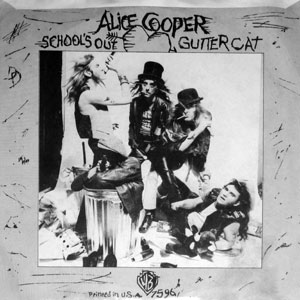
“School’s Out” by Alice Cooper is a hard rock and glam rock song released on April 26, 1972 as the only single from the band’s fifth studio album, School’s Out. It was issued through Warner Bros. Records, with “Gutter Cat” as the B-side. The song was written collectively by Alice Cooper, Michael Bruce, Glen Buxton, Dennis Dunaway, and Neal Smith, and produced by Bob Ezrin.
Musically, “School’s Out” is built around a powerful guitar riff created by Glen Buxton, backed by a straightforward hard-rock rhythm section and theatrical vocals. The main personnel consists of Alice Cooper on lead vocals, Glen Buxton on lead guitar, Michael Bruce on rhythm guitar, keyboards, and backing vocals, Dennis Dunaway on bass guitar and backing vocals, and Neal Smith on drums and backing vocals.
The arrangement combines distorted electric guitars, bass, drums, keyboards, group vocals, and children’s voices. Its central guitar riff gives the track its rebellious character, while the backing vocals make the chorus feel like a collective schoolyard chant rather than a conventional rock refrain. The recording ends with the sound of a school bell, reinforcing the theme of students finally escaping the classroom.
The idea for the song came from Alice Cooper thinking about the most exciting moments of childhood. He compared Christmas morning with the final minutes of the last day of school, describing that moment before summer vacation as a “slow fuse burning.” The band tried to capture that feeling of anticipation and release in a three-minute rock song.
Another inspiration came from a line Cooper remembered from a Bowery Boys film. He also later joked on his radio show that the main riff had been inspired by Miles Davis, although this was clarified as a joke. The actual opening riff was created by guitarist Glen Buxton.
Lyrically, “School’s Out” takes the fantasy of summer vacation to an exaggerated extreme. School is not merely finished for the year: the lyrics imagine it being finished forever, even suggesting that the building itself has been destroyed. The song also incorporates the familiar childhood rhyme about having “no more pencils” and “no more books,” helping it sound like a rebellious playground chant.
Children also contributed vocals to the recording, strengthening the connection between the song and the excitement of leaving school. In live performances, Cooper has sometimes altered the lyric about having “no innocence,” replacing it with words such as “intelligence” or “etiquette.”
One curiosity is that some radio stations initially banned the song, arguing that it encouraged rebellious attitudes toward education. Teachers, parents, principals, counselors, and psychologists were among those who objected to it. The controversy only reinforced Alice Cooper’s image as a provocative theatrical rock act.
Commercially, “School’s Out” became Alice Cooper’s biggest international hit at the time. It reached No. 7 on the Billboard Hot 100, No. 3 in Canada, No. 2 in Ireland, and No. 1 on the UK Singles Chart, where it remained at the top for three weeks. Its success also helped push the School’s Out album to No. 2 on the Billboard 200.
The single version differs slightly from the album recording. It was mixed in narrower stereo and sped up slightly, while the ending handles the school-bell sound differently. On the album, the bell and sound effects use a “turn-off” effect, whereas the single simply lets them fade away.
Another interesting connection appeared years later in Alice Cooper’s concerts. He began incorporating part of Pink Floyd’s “Another Brick in the Wall, Part 2” into performances of “School’s Out.” Both songs revolve around school rebellion, and both were produced by Bob Ezrin, creating a natural musical link between the two rock anthems.
The song became a lasting part of popular culture, appearing in films and television series including Rock ’n’ Roll High School, Dazed and Confused, Scream, The Simpsons, and Family Guy. In a particularly self-aware use of the song, Alice Cooper appeared in a 2004 Staples back-to-school commercial, joking about the contrast between the song’s anti-school celebration and the shopping season for returning students.
“School’s Out” was inducted into the Grammy Hall of Fame in 2015 and has remained Alice Cooper’s signature song. Its combination of a memorable guitar riff, hard-rock rhythm section, children’s chant, theatrical humor, and universal excitement about the final day of school helped turn it into one of the defining glam-rock anthems of the 1970s.
Lyrics
Well, we got no choice
All the girls and boys
Makin' all that noise
'Cause they found new toys
Well, we can't salute ya
Can't find a flag
If that don't suit ya
That's a drag
School's out for summer
School's out forever
School's been blown to pieces
No more pencils
No more books
No more teacher's dirty looks, yeah
Well, we got no class
And we got no principles
And we got no innocence
We can't even think of a word that rhymes
School's out for summer
School's out forever
School's been blown to pieces
No more pencils
No more books
No more teacher's dirty looks
Out for summer
Out 'til fall
We might not go back at all
School's out for summer
School's out forever
School's been blown to pieces
School's out completely
Youtube video
Songs links
Specification
“School’s Out” by Alice Cooper is a hard rock and glam rock song released on April 26, 1972 as the only single from the band’s fifth studio album, School’s Out. It was issued through Warner Bros. Records, with “Gutter Cat” as the B-side. The song was written collectively by Alice Cooper, Michael Bruce, Glen Buxton, Dennis Dunaway, and Neal Smith, and produced by Bob Ezrin.
Musically, “School’s Out” is built around a powerful guitar riff created by Glen Buxton, backed by a straightforward hard-rock rhythm section and theatrical vocals. The main personnel consists of Alice Cooper on lead vocals, Glen Buxton on lead guitar, Michael Bruce on rhythm guitar, keyboards, and backing vocals, Dennis Dunaway on bass guitar and backing vocals, and Neal Smith on drums and backing vocals.
The arrangement combines distorted electric guitars, bass, drums, keyboards, group vocals, and children’s voices. Its central guitar riff gives the track its rebellious character, while the backing vocals make the chorus feel like a collective schoolyard chant rather than a conventional rock refrain. The recording ends with the sound of a school bell, reinforcing the theme of students finally escaping the classroom.
The idea for the song came from Alice Cooper thinking about the most exciting moments of childhood. He compared Christmas morning with the final minutes of the last day of school, describing that moment before summer vacation as a “slow fuse burning.” The band tried to capture that feeling of anticipation and release in a three-minute rock song.
Another inspiration came from a line Cooper remembered from a Bowery Boys film. He also later joked on his radio show that the main riff had been inspired by Miles Davis, although this was clarified as a joke. The actual opening riff was created by guitarist Glen Buxton.
Lyrically, “School’s Out” takes the fantasy of summer vacation to an exaggerated extreme. School is not merely finished for the year: the lyrics imagine it being finished forever, even suggesting that the building itself has been destroyed. The song also incorporates the familiar childhood rhyme about having “no more pencils” and “no more books,” helping it sound like a rebellious playground chant.
Children also contributed vocals to the recording, strengthening the connection between the song and the excitement of leaving school. In live performances, Cooper has sometimes altered the lyric about having “no innocence,” replacing it with words such as “intelligence” or “etiquette.”
One curiosity is that some radio stations initially banned the song, arguing that it encouraged rebellious attitudes toward education. Teachers, parents, principals, counselors, and psychologists were among those who objected to it. The controversy only reinforced Alice Cooper’s image as a provocative theatrical rock act.
Commercially, “School’s Out” became Alice Cooper’s biggest international hit at the time. It reached No. 7 on the Billboard Hot 100, No. 3 in Canada, No. 2 in Ireland, and No. 1 on the UK Singles Chart, where it remained at the top for three weeks. Its success also helped push the School’s Out album to No. 2 on the Billboard 200.
The single version differs slightly from the album recording. It was mixed in narrower stereo and sped up slightly, while the ending handles the school-bell sound differently. On the album, the bell and sound effects use a “turn-off” effect, whereas the single simply lets them fade away.
Another interesting connection appeared years later in Alice Cooper’s concerts. He began incorporating part of Pink Floyd’s “Another Brick in the Wall, Part 2” into performances of “School’s Out.” Both songs revolve around school rebellion, and both were produced by Bob Ezrin, creating a natural musical link between the two rock anthems.
The song became a lasting part of popular culture, appearing in films and television series including Rock ’n’ Roll High School, Dazed and Confused, Scream, The Simpsons, and Family Guy. In a particularly self-aware use of the song, Alice Cooper appeared in a 2004 Staples back-to-school commercial, joking about the contrast between the song’s anti-school celebration and the shopping season for returning students.
“School’s Out” was inducted into the Grammy Hall of Fame in 2015 and has remained Alice Cooper’s signature song. Its combination of a memorable guitar riff, hard-rock rhythm section, children’s chant, theatrical humor, and universal excitement about the final day of school helped turn it into one of the defining glam-rock anthems of the 1970s.
Specification
“School’s Out” by Alice Cooper is a hard rock and glam rock song released on April 26, 1972 as the only single from the band’s fifth studio album, School’s Out. It was issued through Warner Bros. Records, with “Gutter Cat” as the B-side. The song was written collectively by Alice Cooper, Michael Bruce, Glen Buxton, Dennis Dunaway, and Neal Smith, and produced by Bob Ezrin.
Musically, “School’s Out” is built around a powerful guitar riff created by Glen Buxton, backed by a straightforward hard-rock rhythm section and theatrical vocals. The main personnel consists of Alice Cooper on lead vocals, Glen Buxton on lead guitar, Michael Bruce on rhythm guitar, keyboards, and backing vocals, Dennis Dunaway on bass guitar and backing vocals, and Neal Smith on drums and backing vocals.
The arrangement combines distorted electric guitars, bass, drums, keyboards, group vocals, and children’s voices. Its central guitar riff gives the track its rebellious character, while the backing vocals make the chorus feel like a collective schoolyard chant rather than a conventional rock refrain. The recording ends with the sound of a school bell, reinforcing the theme of students finally escaping the classroom.
The idea for the song came from Alice Cooper thinking about the most exciting moments of childhood. He compared Christmas morning with the final minutes of the last day of school, describing that moment before summer vacation as a “slow fuse burning.” The band tried to capture that feeling of anticipation and release in a three-minute rock song.
Another inspiration came from a line Cooper remembered from a Bowery Boys film. He also later joked on his radio show that the main riff had been inspired by Miles Davis, although this was clarified as a joke. The actual opening riff was created by guitarist Glen Buxton.
Lyrically, “School’s Out” takes the fantasy of summer vacation to an exaggerated extreme. School is not merely finished for the year: the lyrics imagine it being finished forever, even suggesting that the building itself has been destroyed. The song also incorporates the familiar childhood rhyme about having “no more pencils” and “no more books,” helping it sound like a rebellious playground chant.
Children also contributed vocals to the recording, strengthening the connection between the song and the excitement of leaving school. In live performances, Cooper has sometimes altered the lyric about having “no innocence,” replacing it with words such as “intelligence” or “etiquette.”
One curiosity is that some radio stations initially banned the song, arguing that it encouraged rebellious attitudes toward education. Teachers, parents, principals, counselors, and psychologists were among those who objected to it. The controversy only reinforced Alice Cooper’s image as a provocative theatrical rock act.
Commercially, “School’s Out” became Alice Cooper’s biggest international hit at the time. It reached No. 7 on the Billboard Hot 100, No. 3 in Canada, No. 2 in Ireland, and No. 1 on the UK Singles Chart, where it remained at the top for three weeks. Its success also helped push the School’s Out album to No. 2 on the Billboard 200.
The single version differs slightly from the album recording. It was mixed in narrower stereo and sped up slightly, while the ending handles the school-bell sound differently. On the album, the bell and sound effects use a “turn-off” effect, whereas the single simply lets them fade away.
Another interesting connection appeared years later in Alice Cooper’s concerts. He began incorporating part of Pink Floyd’s “Another Brick in the Wall, Part 2” into performances of “School’s Out.” Both songs revolve around school rebellion, and both were produced by Bob Ezrin, creating a natural musical link between the two rock anthems.
The song became a lasting part of popular culture, appearing in films and television series including Rock ’n’ Roll High School, Dazed and Confused, Scream, The Simpsons, and Family Guy. In a particularly self-aware use of the song, Alice Cooper appeared in a 2004 Staples back-to-school commercial, joking about the contrast between the song’s anti-school celebration and the shopping season for returning students.
“School’s Out” was inducted into the Grammy Hall of Fame in 2015 and has remained Alice Cooper’s signature song. Its combination of a memorable guitar riff, hard-rock rhythm section, children’s chant, theatrical humor, and universal excitement about the final day of school helped turn it into one of the defining glam-rock anthems of the 1970s.
Specification
“School’s Out” by Alice Cooper is a hard rock and glam rock song released on April 26, 1972 as the only single from the band’s fifth studio album, School’s Out. It was issued through Warner Bros. Records, with “Gutter Cat” as the B-side. The song was written collectively by Alice Cooper, Michael Bruce, Glen Buxton, Dennis Dunaway, and Neal Smith, and produced by Bob Ezrin.
Musically, “School’s Out” is built around a powerful guitar riff created by Glen Buxton, backed by a straightforward hard-rock rhythm section and theatrical vocals. The main personnel consists of Alice Cooper on lead vocals, Glen Buxton on lead guitar, Michael Bruce on rhythm guitar, keyboards, and backing vocals, Dennis Dunaway on bass guitar and backing vocals, and Neal Smith on drums and backing vocals.
The arrangement combines distorted electric guitars, bass, drums, keyboards, group vocals, and children’s voices. Its central guitar riff gives the track its rebellious character, while the backing vocals make the chorus feel like a collective schoolyard chant rather than a conventional rock refrain. The recording ends with the sound of a school bell, reinforcing the theme of students finally escaping the classroom.
The idea for the song came from Alice Cooper thinking about the most exciting moments of childhood. He compared Christmas morning with the final minutes of the last day of school, describing that moment before summer vacation as a “slow fuse burning.” The band tried to capture that feeling of anticipation and release in a three-minute rock song.
Another inspiration came from a line Cooper remembered from a Bowery Boys film. He also later joked on his radio show that the main riff had been inspired by Miles Davis, although this was clarified as a joke. The actual opening riff was created by guitarist Glen Buxton.
Lyrically, “School’s Out” takes the fantasy of summer vacation to an exaggerated extreme. School is not merely finished for the year: the lyrics imagine it being finished forever, even suggesting that the building itself has been destroyed. The song also incorporates the familiar childhood rhyme about having “no more pencils” and “no more books,” helping it sound like a rebellious playground chant.
Children also contributed vocals to the recording, strengthening the connection between the song and the excitement of leaving school. In live performances, Cooper has sometimes altered the lyric about having “no innocence,” replacing it with words such as “intelligence” or “etiquette.”
One curiosity is that some radio stations initially banned the song, arguing that it encouraged rebellious attitudes toward education. Teachers, parents, principals, counselors, and psychologists were among those who objected to it. The controversy only reinforced Alice Cooper’s image as a provocative theatrical rock act.
Commercially, “School’s Out” became Alice Cooper’s biggest international hit at the time. It reached No. 7 on the Billboard Hot 100, No. 3 in Canada, No. 2 in Ireland, and No. 1 on the UK Singles Chart, where it remained at the top for three weeks. Its success also helped push the School’s Out album to No. 2 on the Billboard 200.
The single version differs slightly from the album recording. It was mixed in narrower stereo and sped up slightly, while the ending handles the school-bell sound differently. On the album, the bell and sound effects use a “turn-off” effect, whereas the single simply lets them fade away.
Another interesting connection appeared years later in Alice Cooper’s concerts. He began incorporating part of Pink Floyd’s “Another Brick in the Wall, Part 2” into performances of “School’s Out.” Both songs revolve around school rebellion, and both were produced by Bob Ezrin, creating a natural musical link between the two rock anthems.
The song became a lasting part of popular culture, appearing in films and television series including Rock ’n’ Roll High School, Dazed and Confused, Scream, The Simpsons, and Family Guy. In a particularly self-aware use of the song, Alice Cooper appeared in a 2004 Staples back-to-school commercial, joking about the contrast between the song’s anti-school celebration and the shopping season for returning students.
“School’s Out” was inducted into the Grammy Hall of Fame in 2015 and has remained Alice Cooper’s signature song. Its combination of a memorable guitar riff, hard-rock rhythm section, children’s chant, theatrical humor, and universal excitement about the final day of school helped turn it into one of the defining glam-rock anthems of the 1970s.