
Description
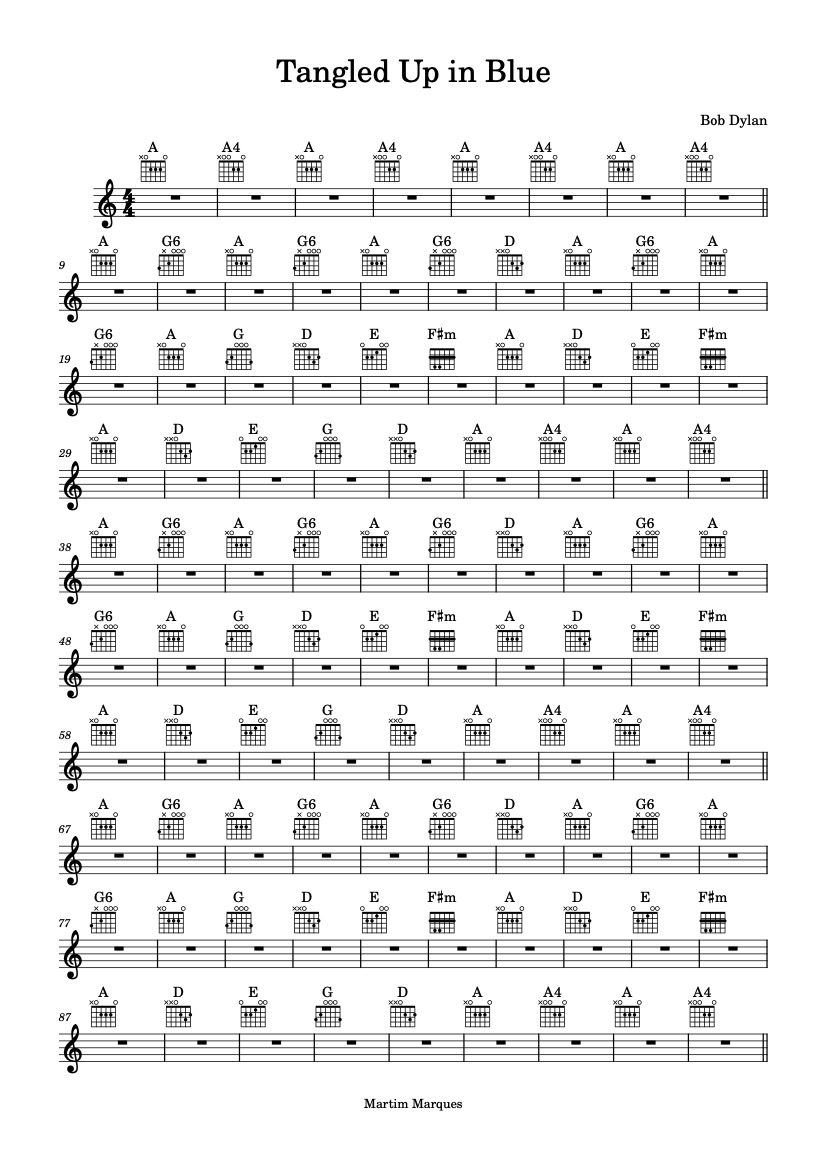
“Tangled Up in Blue” by Bob Dylan is a folk rock song from his 1975 album Blood on the Tracks. It was released by Columbia Records as the album’s sole single, backed with “If You See Her, Say Hello.” The song was written by Bob Dylan and produced by his brother David Zimmerman, although Zimmerman was not credited on the original album. The version released on Blood on the Tracks was recorded on December 30, 1974 at Sound 80 in Minneapolis, Minnesota.
The song is one of Dylan’s most celebrated narrative compositions. It opens Blood on the Tracks and tells a fragmented story of love, distance, memory, separation, and emotional change. Rather than following a simple chronological storyline, the lyrics move between different moments in time and different narrative points of view, creating the feeling of memories being revisited and rearranged.
Musically, “Tangled Up in Blue” is built around an acoustic folk rock arrangement. The main instruments in the released version include Bob Dylan’s lead vocals, acoustic rhythm guitar, and harmonica, plus acoustic lead guitars, keyboards, bass guitar, and drums. The credited musicians are Bob Dylan on lead vocals, acoustic rhythm guitar, and harmonica, Kevin Odegard on acoustic lead guitar, Chris Weber on acoustic lead guitar, Gregg Inhofer on keyboards, Billy Peterson on bass guitar, and Bill Berg on drums.
One of the most important curiosities about the song is that it was first recorded in New York City in September 1974 during the original Blood on the Tracks sessions. Those earlier takes were more intimate and mostly featured Dylan on guitar and harmonica with Tony Brown on bass. Later, after a suggestion from David Zimmerman that the album needed a more commercial sound, Dylan re-recorded several songs in Minneapolis, including “Tangled Up in Blue.”
The song was written during a turbulent period in Dylan’s life, after his 1974 comeback tour with The Band and around the time of his separation from Sara Dylan. However, Dylan later resisted purely autobiographical interpretations of Blood on the Tracks, saying the album was not simply about his own life and describing it instead as a concept built from images that connect yesterday, today, and tomorrow in unusual ways.
Another major curiosity is the influence of Dylan’s art studies with Norman Raeben at Carnegie Hall. The article notes that Raeben’s ideas about time influenced Dylan’s writing on Blood on the Tracks. Dylan later explained that the lyrics had “no sense of time,” with past, present, and future occupying the same imaginative space. This helps explain the song’s shifting narrative voice and its unusual emotional structure.
Dylan has also changed “Tangled Up in Blue” many times in live performance. The article notes that he altered the lyrics, point of view, and details in later versions, including changes during his 1978 tour and a radically reworked 1984 live version. Dylan once said the song took “ten years to live and two years to write,” highlighting how deeply connected it was to lived experience, memory, and revision.
Commercially, “Tangled Up in Blue” reached No. 31 on the Billboard Hot 100. Its chart position was modest compared with some classic rock singles, but its critical reputation has grown enormously. Rolling Stone ranked it among the greatest songs of all time, placing it at No. 68 on its 2011 list of the 500 Greatest Songs of All Time and No. 67 in the 2021 update.
Another interesting detail is that Dylan has performed the song live more than 1,600 times. A solo acoustic performance from the 1975 Rolling Thunder Revue appeared in Dylan’s film Renaldo and Clara and later became the song’s official music video. Over the years, the song has also been covered or referenced by artists such as Jerry Garcia, Joan Baez, Indigo Girls, Ani DiFranco, KT Tunstall, and Hootie & the Blowfish.
From a music discovery and SEO perspective, “Tangled Up in Blue” is ideal for listeners searching for Bob Dylan songs, Blood on the Tracks tracks, 1970s folk rock, acoustic Dylan songs, songs about lost love, narrative songwriting, harmonica folk rock, or classic songs with shifting perspectives. Its poetic storytelling, acoustic instrumentation, restless narrative voice, and constant lyrical evolution make it one of Dylan’s most admired and enduring songs.
Lyrics
Youtube Video
Social Links
Song
Description
“Tangled Up in Blue” by Bob Dylan is a folk rock song from his 1975 album Blood on the Tracks. It was released by Columbia Records as the album’s sole single, backed with “If You See Her, Say Hello.” The song was written by Bob Dylan and produced by his brother David Zimmerman, although Zimmerman was not credited on the original album. The version released on Blood on the Tracks was recorded on December 30, 1974 at Sound 80 in Minneapolis, Minnesota.
The song is one of Dylan’s most celebrated narrative compositions. It opens Blood on the Tracks and tells a fragmented story of love, distance, memory, separation, and emotional change. Rather than following a simple chronological storyline, the lyrics move between different moments in time and different narrative points of view, creating the feeling of memories being revisited and rearranged.
Musically, “Tangled Up in Blue” is built around an acoustic folk rock arrangement. The main instruments in the released version include Bob Dylan’s lead vocals, acoustic rhythm guitar, and harmonica, plus acoustic lead guitars, keyboards, bass guitar, and drums. The credited musicians are Bob Dylan on lead vocals, acoustic rhythm guitar, and harmonica, Kevin Odegard on acoustic lead guitar, Chris Weber on acoustic lead guitar, Gregg Inhofer on keyboards, Billy Peterson on bass guitar, and Bill Berg on drums.
One of the most important curiosities about the song is that it was first recorded in New York City in September 1974 during the original Blood on the Tracks sessions. Those earlier takes were more intimate and mostly featured Dylan on guitar and harmonica with Tony Brown on bass. Later, after a suggestion from David Zimmerman that the album needed a more commercial sound, Dylan re-recorded several songs in Minneapolis, including “Tangled Up in Blue.”
The song was written during a turbulent period in Dylan’s life, after his 1974 comeback tour with The Band and around the time of his separation from Sara Dylan. However, Dylan later resisted purely autobiographical interpretations of Blood on the Tracks, saying the album was not simply about his own life and describing it instead as a concept built from images that connect yesterday, today, and tomorrow in unusual ways.
Another major curiosity is the influence of Dylan’s art studies with Norman Raeben at Carnegie Hall. The article notes that Raeben’s ideas about time influenced Dylan’s writing on Blood on the Tracks. Dylan later explained that the lyrics had “no sense of time,” with past, present, and future occupying the same imaginative space. This helps explain the song’s shifting narrative voice and its unusual emotional structure.
Dylan has also changed “Tangled Up in Blue” many times in live performance. The article notes that he altered the lyrics, point of view, and details in later versions, including changes during his 1978 tour and a radically reworked 1984 live version. Dylan once said the song took “ten years to live and two years to write,” highlighting how deeply connected it was to lived experience, memory, and revision.
Commercially, “Tangled Up in Blue” reached No. 31 on the Billboard Hot 100. Its chart position was modest compared with some classic rock singles, but its critical reputation has grown enormously. Rolling Stone ranked it among the greatest songs of all time, placing it at No. 68 on its 2011 list of the 500 Greatest Songs of All Time and No. 67 in the 2021 update.
Another interesting detail is that Dylan has performed the song live more than 1,600 times. A solo acoustic performance from the 1975 Rolling Thunder Revue appeared in Dylan’s film Renaldo and Clara and later became the song’s official music video. Over the years, the song has also been covered or referenced by artists such as Jerry Garcia, Joan Baez, Indigo Girls, Ani DiFranco, KT Tunstall, and Hootie & the Blowfish.
From a music discovery and SEO perspective, “Tangled Up in Blue” is ideal for listeners searching for Bob Dylan songs, Blood on the Tracks tracks, 1970s folk rock, acoustic Dylan songs, songs about lost love, narrative songwriting, harmonica folk rock, or classic songs with shifting perspectives. Its poetic storytelling, acoustic instrumentation, restless narrative voice, and constant lyrical evolution make it one of Dylan’s most admired and enduring songs.